


5 min readUpdated
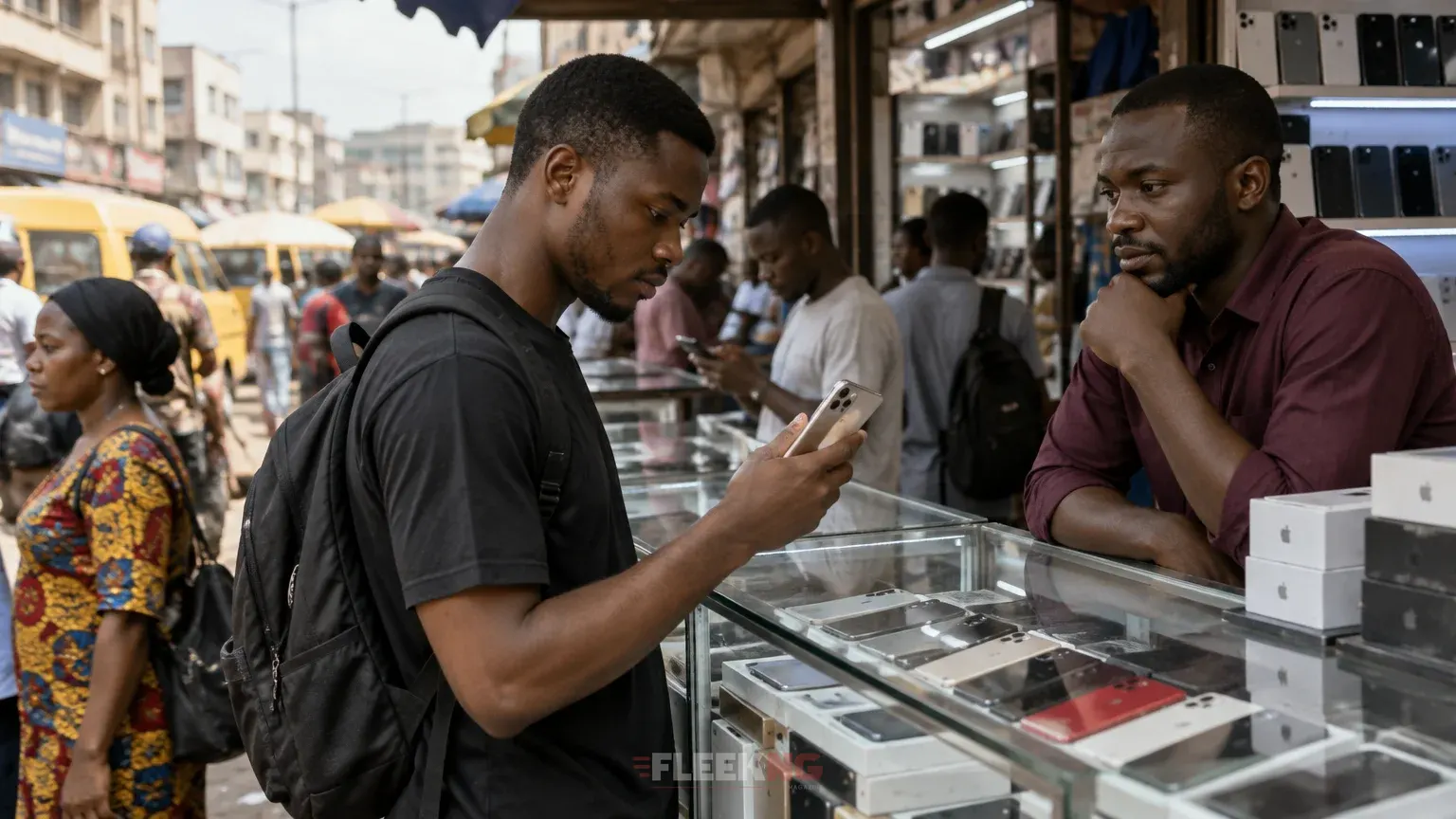
Walk through Computer Village in Ikeja on any weekday and you will see more iPhones than you can count: new ones in sealed boxes, tokunbo (foreign used) ones in glass cases, and cracked ones waiting for a new screen. Plenty of people carry one. Far fewer know the story behind it. If you came looking for iPhone 15 Pro facts, this is the wider story.
Here are ten true facts about the iPhone, from a phone Apple sketched in 1983 to the time shown in its adverts. None of them depends on which model you own, so they will still be true next year.
These iPhone 15 Pro facts include checks to make before you buy a used one or another model.
Alongside iPhone history, these iPhone 15 Pro facts offer checks for anyone buying a used phone.
Before there was an iPhone
1. Apple sketched a touchscreen phone in 1983
Over twenty years before the iPhone, the designer Hartmut Esslinger, the man behind Apple’s “Snow White” design style of the 1980s, created a concept phone for the company. It was a desk phone with a corded handset, but it also had a touchscreen you worked with a stylus. It never went on sale, and pictures of it only became widely known in 2011.
There is some irony there. When Steve Jobs finally unveiled the iPhone, he made a point of mocking phones that needed a stylus.
2. The project was codenamed Purple
Inside Apple, the iPhone was developed under the codename Purple, and the secrecy was strict. Giving evidence in court in 2012, Apple executive Scott Forstall said the first rule of Project Purple was that you were not allowed to talk about it outside those doors.
The launch and the name
3. It was unveiled on 9 January 2007
Steve Jobs introduced the iPhone at the Macworld conference in San Francisco on 9 January 2007. It did not go on sale until 29 June 2007, and then only in the United States.
4. The clock in Apple’s photos says 9:41
Look at almost any official iPhone photo and the time on the screen is 9:41. Apple’s big keynotes started at 9am, and the main reveal was planned for about 40 minutes in, so the time on the device would roughly match the time in the room. The first iPhone actually appeared on screen at around 9:42, and early photos showed that, but Apple soon settled on 9:41 and has stuck with it.
5. Apple did not own the name at first
The iPhone trademark belonged to Cisco, the networking company, which got it when it bought a firm called InfoGear in 2000. Cisco’s Linksys division had started selling internet phones under the iPhone name in 2006. Cisco sued Apple within days of the 2007 announcement. The two companies settled in February 2007 and agreed that both could use the name around the world.
What the first iPhone could not do
6. There was no App Store
The first iPhone came only with Apple’s own apps. You could not install apps from other developers, because the App Store did not exist. It opened on 10 July 2008, alongside the iPhone 3G, with about 500 apps.
7. No copy and paste, no video and no 3G
The original iPhone could not copy and paste text. That arrived with a software update in June 2009. It could not record video either, a feature that first came with the iPhone 3GS that same year, and it ran on slower EDGE mobile data because it had no 3G.
The glass, the chips and the voice
8. The glass screen was a late change
Early iPhone prototypes had a plastic screen. Steve Jobs carried one in his pocket, saw how easily it scratched, and insisted on glass. Apple turned to Corning, the American glass maker, which rushed to produce a thin, tough glass in time for launch. The material was later sold as Gorilla Glass, and it now protects phones from many brands.
9. Apple designs its chips, but TSMC makes them
You may have heard that Samsung makes the iPhone’s processor. That was true of the early models. Apple designs its own A-series chips, and since 2016 they have been manufactured by TSMC, the Taiwan Semiconductor Manufacturing Company. Samsung is still an important supplier, though. It has made the OLED screens for many iPhone models.
10. Siri began as a separate app
Siri was not invented at Apple. It started as an independent app on the App Store in early 2010. Apple bought the company behind it that April, and in October 2011 Siri returned as a built-in feature of the iPhone 4S, while the old app was withdrawn.
iPhone 15 Pro facts: checks before you buy a used one or another model
A tokunbo iPhone from Computer Village or an online seller can be good value. If you are looking up iPhone 15 Pro facts before buying a used one, these checks can help you avoid common traps. They apply to other models too.
- Battery health. Open Settings, then Battery, then Battery Health (on some models it is called Battery Health and Charging). Maximum Capacity shows how much of the original battery is left. A low figure means a replacement is coming, so factor that into the price.
- Parts and service history. Go to Settings, then General, then About. If the phone has been repaired, a Parts and Service History section shows whether parts such as the battery, screen or camera are genuine Apple parts.
- Activation Lock. Ask the seller to sign out of their Apple account and turn off Find My in front of you, then erase the phone. If it asks for the previous owner’s details when you set it up, do not buy it.
- Payment. Meet somewhere public and check the phone fully before you pay. If you are selling your old phone to fund the upgrade, do not hand it over until the money shows in your own banking app. Our guide on how to spot a fake alert explains why.
Once the phone is yours, set up a backup before anything else. If space is tight, our guide to freeing up phone storage and backing up safely walks you through it.
Get new stories by email
Practical guides on money, work, tech and culture. No spam, and you can leave at any time.

